
HOGA ALEMBICS
All soldered, copper condenser, thermometer, drain port and valve included. 100 LITRE … EUR 1,200 *Sku: HS100 200 LITRE … EUR 1,730 *Sku: HS200 Plus packing and shipping.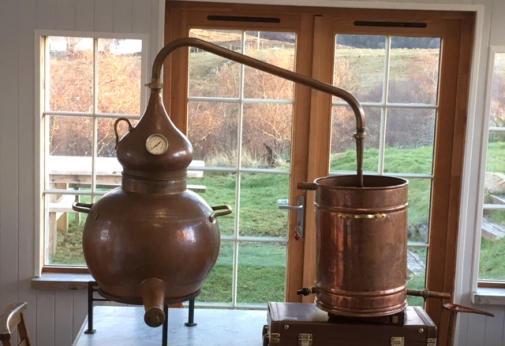
HOGA, SMALL COPPER ALEMBICS PRICE LIST
The
Hoga
copper
alembic
is
an
excellent
alembic
for
producing
homemade
spirits
(brandy,
whiskey,
eau-
de-vie,
rum),
manufactured
by
the
Hoga
Company.
As
it
is
a
very
small
alembic,
it
obviously
does
not
have
the
same
extras
installed
in
the
professional
stills
that
Hoga
makes
for
micro-distilleries.
Too
small,
perhaps,
but
you'll
be
surprised
if
we
tell
you
that
many
distilleries
use
small
copper
alembics
as
pilot
still
for
sampling
and
small
tests
before
going
to
the
final
distillation.
Too
small?
Yes,
but
the
best
taste
and
aroma ever.


€185.00: 5 liter copper alembic
€247.00: 10 liter copper alembic
€319.00: 20 liter copper alembic
€376.00: 30 liter copper alembic

Plus packing & shipping costs
€650.00: 40 liter small pot still
€897.00: 60 liter small pot still
€983.00: 80 liter small pot still
(Brass unions, thermometer & condenser)
Copper lentils for copper
alembics over 80 litres
Solid Copper Alembic 99.9% pure. Same shape for
50L - 100L - 200L

Parrot Beak for
small copper
alembics
Sku:
Eur 85.00 each
40 litre /// €Sku: RC40
50 litre /// €Sku: RC50
80 litre /// €Sku: RC80
ROTARY
COLUMN
ALEMBIC
Handmade Copper Alembic


Plus packing & shipping costs
© HOGA COMPANY COPPER POT STILL LTDA - PORTO PORTUGAL - 2026

100 litre /// €Sku: RC100
120 litre /// €Sku: RC120
150 litre /// €Sku: RC150
Prof parrot Beak
for Hoga Stills
Sku:
Eur 150.00 each
.jpg)
Brass unions, thermometer & condenser
Plus shipping costs


Did you know this?
All copper stills with a capacity of less than 30 liters are micro in size, and the onion shape style differs little from manufacturer to manufacturer, except in
price. But that’s not quite true.
Did you know that some alembics are handmade, without a mold, using only the craftman’s skill, a copper disc, a hammer, and a piece of wood as workbench,
hammering each time until the pot is fully raised up, followed by a hammer finish for a robust and perfect hammered look, while some other models are
turned on a turret lathe, using a thinner copper sheet and a hammered steel mold to give the hammered appearance? And what about the condenser’s metal
sheet, how is it made? Is it an industrially hammered metal sheet?
Also make sure that no leaded solder is used on any metal joints, not even the brass joint that connects the thermometer probe to the still helmet.
Cheap can be expensive, right?

HOGA ALEMBICS
All soldered, copper condenser, thermometer, drain port and valve included. 100 LITRE … EUR 1,200.oo *Sku: HS100 200 LITRE … EUR 1,730.00 *Sku: HS200 Plus packing and shipping.


Brass unions, thermometer and condenser
Plus shipping costs
HOGA, SMALL COPPER ALEMBICS PRICE LIST
The
Hoga
copper
alembic
is
an
excellent
alembic
for
producing
homemade
spirits
(brandy,
whiskey,
eau-
de-vie,
rum),
manufactured
by
the
Hoga
Company.
As
it
is
a
very
small
alembic,
it
obviously
does
not
have
the
same
extras
installed
in
the
professional
stills
that
Hoga
makes
for
micro-distilleries.
Too
small,
perhaps,
but
you'll
be
surprised
if
we
tell
you
that
many
distilleries
use
small
copper
alembics
as
pilot
still
for
sampling
and
small
tests
before
going
to
the
final
distillation.
Too
small?
Yes,
but
the
best
taste
and
aroma ever.
AVAILABLE IN ECWID:
https://hoga-alembics.company.site
€185.00: 5 liter copper alembic
€247.00: 10 liter copper alembic
€319.00: 20 liter copper alembic
€376.00: 30 liter copper alembic
€650.00: 40 liter small pot still
€897.00: 60 liter small pot still
€983.00: 80 liter small pot still
Plus packing & shipping costs
ROTARY
COLUMN
ALEMBIC

40 litre /// €Sku: RC40
50 litre /// €Sku: RC50
80 litre /// €Sku: RC80
Plus packing & shipping costs
Brass unions, thermometer & condenser
Plus shipping costs


